
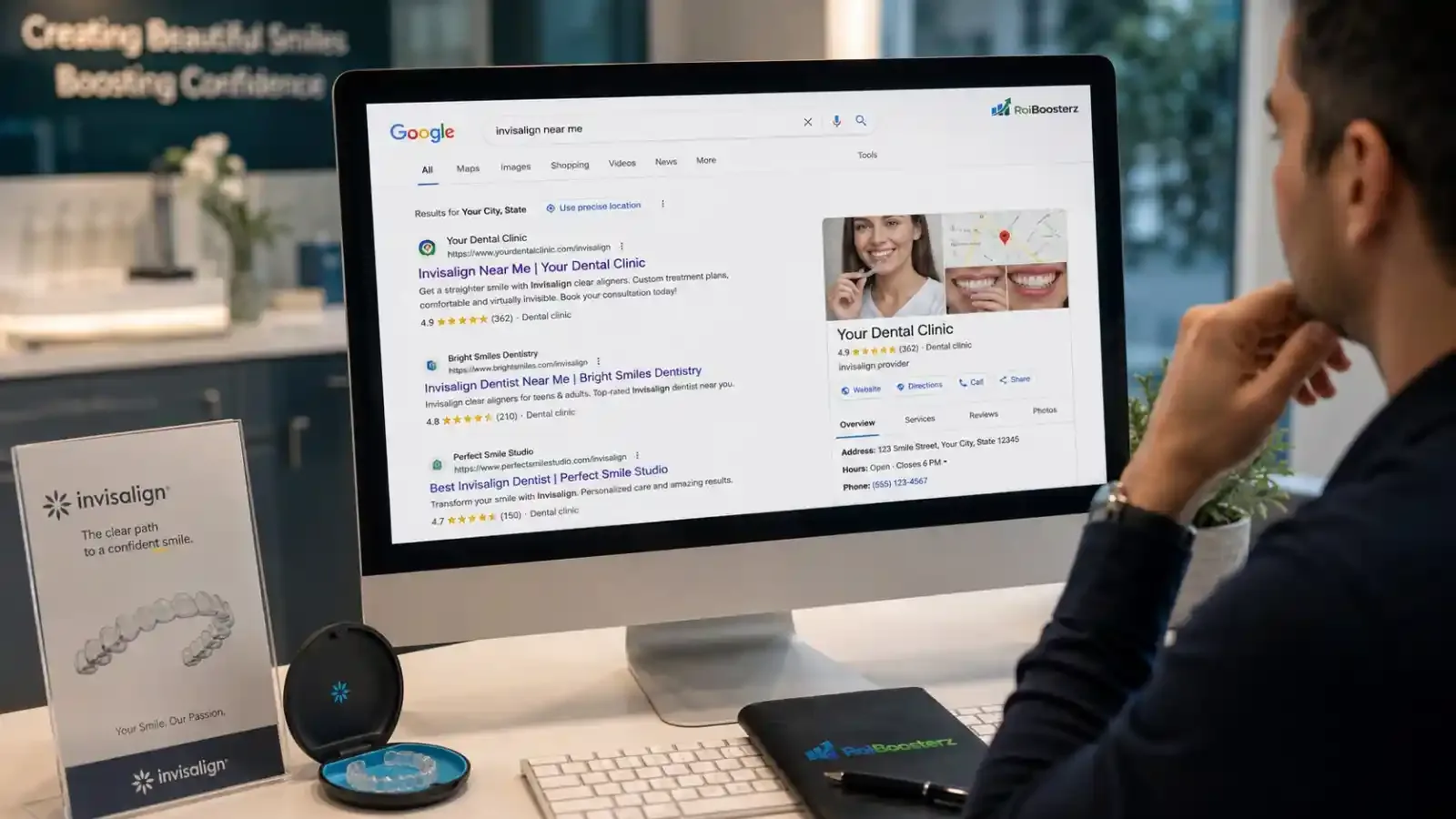
Invisalign SEO: How to Rank and Get More Invisalign Patients from Google
Invisalign SEO is the process of optimizing your dental or orthodontic website to rank for Invisalign-related searches. The core searches are "Invisalign near me," "Invisalign cost [city]," and "Invisalign dentist [city]." Ranking for them requires a dedicated Invisalign page, a content cluster answering common patient questions, Google Business Profile optimization with Invisalign-specific categories, and a conversion path built around the way Invisalign patients actually research and decide. Practices that build this system generate a steady flow of new Invisalign cases from organic search without paying per click.
Why Invisalign SEO Is Different From General Dental SEO
Invisalign is the most-searched elective dental treatment on Google. According to Ahrefs keyword data, "Invisalign near me" generates over 450,000 monthly searches in the United States, making it one of the highest-volume local dental keywords any practice can target. "Invisalign cost" generates over 200,000 monthly searches on top of that. These are not curiosity searches. They come from patients who have already decided they want straighter teeth and are now evaluating which practice to trust with that treatment.
That intent profile is what makes Invisalign SEO worth prioritizing. A patient searching "Invisalign dentist [city]" is further along in the decision process than one searching "how to straighten teeth." They are ready to consult. The SEO investment to capture them is the same as capturing any other treatment keyword, but the revenue per converted patient is considerably higher. Average Invisalign treatment fees range from $3,000 to $8,000 depending on case complexity and market.
One more thing that sets Invisalign SEO apart: it involves a trademarked brand name. Using "Invisalign" in your content, page titles, and Google Business Profile is permitted for Align Technology's authorized providers, and it is the right SEO approach because patients search the brand name, not the generic term "clear aligners."
Our SEO for orthodontist page covers the broader orthodontic SEO strategy that Invisalign optimization falls under.
Step 1: Build a Dedicated Invisalign Page That Ranks
A dedicated Invisalign page is the foundation of Invisalign SEO. Practices that list Invisalign as one of twelve services on a single "Services" page will not rank for competitive Invisalign keywords. Google ranks individual pages, not websites. Each treatment needs its own space to build its own ranking signal.
A high-performing Invisalign page needs these elements:
Title tag and H1 should read "Invisalign in [City] | [Practice Name]" or "Invisalign Dentist [City]." The city modifier is essential for local ranking. Without it, the page competes nationally against Align Technology's own website, major dental chains, and authoritative health publishers, which no single-location practice can realistically beat.
Treatment overview should explain what Invisalign is, how it works, and who it suits. Write for the patient researching, not the clinician who already knows. Cover how many aligners, how often they are changed, and what results to expect in plain language.
Case suitability should specify which alignment issues Invisalign addresses: crowding, spacing, overbite, underbite, crossbite. Also note which cases may need an alternative approach. This specificity signals clinical depth to both Google and the patient reading it.
Cost and financing information must be present. According to Google's own Search Quality Evaluator Guidelines, commercial treatment pages that withhold pricing score lower on "meets needs" assessments. A cost range — "Invisalign at our [city] practice typically runs from $X to $X depending on case complexity" — paired with financing options builds trust and captures "Invisalign cost" searches.
Before and after photos from real patients, with consent, showing the types of cases you treat. Visual proof on the treatment page closes the gap between research and booking faster than any written claim.
A clear CTA should appear above the fold and at the bottom of the page. If you offer a free Invisalign consultation, that needs to be visible immediately. A patient who has to scroll to the footer to find your booking option will often leave before finding it.
Step 2: Target the Full Invisalign Keyword Cluster
A single Invisalign page captures high-intent city searches. A supporting content cluster captures the full range of questions patients ask during the research phase and builds the topical authority that strengthens the main page's rankings over time.
According to Semrush's 2024 Keyword Research Data, the top Invisalign-related searches beyond "Invisalign near me" include:
- · "How much does Invisalign cost" — 200,000+ monthly searches
- · "Invisalign before and after" — 90,000+ monthly searches
- · "Invisalign vs braces" — 60,000+ monthly searches
- · "How long does Invisalign take" — 40,000+ monthly searches
- · "Invisalign for adults" — 30,000+ monthly searches
- · "Does Invisalign hurt" — 25,000+ monthly searches
Each of these is a patient question worth answering in a dedicated blog post. A practice that publishes "How much does Invisalign cost in [city]?", "Invisalign vs braces — which is right for you?", and "What to expect during Invisalign treatment" captures patients at every stage of their research, not just those ready to book on the first visit. Internal links from each supporting post back to the main Invisalign page strengthen its ranking signals with every new piece of content published.
Step 3: Optimize Your Google Business Profile for Invisalign Searches
Your Google Business Profile is the primary driver of Invisalign map pack rankings. Patients searching "Invisalign near me" on mobile see the map pack before any organic results, and the three practices listed there capture most of those clicks.
To rank in the map pack for Invisalign searches, four things need to be in place.
Add "Orthodontist" or "Teeth Straightening" as secondary GBP categories beyond your primary "Dentist" category. These secondary categories expand the searches your profile becomes eligible for without weakening the primary signal.
Add Invisalign as a named service in the GBP services section with a short description that includes your city name, treatment details, and a note about the free consultation. GBP service descriptions are indexed by Google and contribute to relevance for treatment-specific searches.
Upload Invisalign-specific photos: before and after results, your Invisalign provider certification display, and photos of patients wearing aligners with consent. According to BrightLocal's 2024 Local Search Survey, profiles with treatment-specific photos receive higher engagement from patients researching that specific treatment.
Ask completed Invisalign patients to mention Invisalign by name in their Google review. Reviews containing the treatment name contribute to your profile's relevance for Invisalign searches. A simple prompt — "If you have a moment, mentioning your Invisalign experience in your Google review helps other patients find us" — naturally generates keyword-relevant review content.
Step 4: Build a Conversion Path for the Invisalign Decision Timeline
Invisalign patients do not book quickly. According to a 2023 Align Technology survey, 67% of patients researched Invisalign for more than one month before scheduling a consultation, and 43% visited three or more dental websites before choosing a provider. Ranking alone is not enough. The practice also needs a conversion path that stays visible throughout the patient's research period.
Three elements make the most difference here.
A free consultation offer, prominently displayed on the treatment page, in the GBP booking link, and in every supporting content piece. It removes the financial barrier to first contact and makes the next step obvious.
An Invisalign cost estimator or calculator on the page keeps research-phase patients engaged longer. A patient who spends four minutes interacting with a cost tool is more likely to book than one who reads two paragraphs and leaves. Longer engagement signals value to Google too.
A Meta Ads retargeting campaign that reaches patients who visited the Invisalign page but did not book. Facebook and Instagram ads showing patient transformation results and a free consultation offer convert the warm audience that SEO already brought in but did not immediately capture. A patient who found you through Google but did not book yet is the most receptive possible audience for a paid social ad.
At ROIBoosterz, every Invisalign SEO campaign we build includes this retargeting layer, because the SEO and paid social channels work together here more effectively than either does alone.
Invisalign SEO Checklist
| Element | Status to Aim For |
|---|---|
| Dedicated Invisalign page | Exists with city in title, H1, and URL |
| Page covers cost, process, suitability, and FAQs | Yes — written in patient-facing language |
| Before and after photos on treatment page | Yes — with patient consent |
| Free consultation CTA above the fold | Prominent — not buried below scroll |
| GBP secondary categories include orthodontic/teeth straightening | Yes — added beyond primary Dentist category |
| GBP services section lists Invisalign with description | Yes — includes city name and consultation offer |
| Supporting content cluster published | 3+ posts targeting Invisalign research questions |
| Internal links from supporting posts to main page | Yes — consistent anchor text throughout |
| Invisalign-specific reviews mentioning brand name | Active review request process in place |
Key Takeaways
- · "Invisalign near me" generates 450,000+ monthly U.S. searches — the highest-volume elective dental keyword available to local practices
- · A dedicated Invisalign page is not optional — a services page listing it among twelve treatments will not rank for competitive Invisalign keywords
- · Including cost information on the Invisalign page captures "Invisalign cost" searches and builds patient trust at the same time
- · GBP secondary categories, Invisalign service descriptions, and treatment-specific photos all contribute to map pack visibility
- · 67% of Invisalign patients research for more than one month before booking — a content cluster and retargeting strategy converts the ones who do not book on the first visit
- · Internal linking from supporting content to the main Invisalign page builds topical authority with every new piece published
Frequently Asked Questions
Ranking for Invisalign searches requires a dedicated Invisalign treatment page with the city name in the title and content, a supporting blog cluster answering common research questions, Google Business Profile optimization with Invisalign listed as a service, and consistent review generation from completed Invisalign patients. Practices that publish a standalone Invisalign page and three to five supporting blog posts typically see initial ranking movement within 3 to 4 months.
Yes. Authorized Invisalign providers are permitted to use the Invisalign trademark in their marketing, including on their website and Google Business Profile. Using the brand name is the right SEO approach because patients search for "Invisalign" specifically rather than the generic term "clear aligners." Check that your practice is listed as an authorized provider on Align Technology's provider locator before publishing.
Ranking for Invisalign keywords typically falls within a standard dental SEO retainer of $750 to $2,500 per month for most single-location practices. More competitive metro markets may require more. The Invisalign-specific work — building the treatment page, creating supporting content, and optimizing the GBP — is part of a complete dental SEO campaign rather than a separate cost on top of it.
Most practices with a new or optimized Invisalign page begin seeing ranking movement within 3 to 5 months. Map pack visibility for "Invisalign near me" searches often improves faster, within 4 to 8 weeks of Google Business Profile optimization and service listing updates. Full page-one rankings for competitive "Invisalign [city]" keywords typically take 5 to 9 months of consistent optimization.
An Invisalign content cluster is a group of related blog posts and pages targeting different research questions around the treatment — cost, timeline, suitability, comparison with braces, before and after results — that all link back to the main Invisalign treatment page. The cluster tells Google this website has genuine authority on the subject of Invisalign, not just a single keyword-optimized page. Practices with content clusters consistently outrank those with a standalone treatment page in competitive local markets.
For a complete orthodontic and Invisalign SEO strategy, our dental seo services page covers how we build treatment-specific campaigns for dental and orthodontic practices.