
Google’s search results page looks nothing like it did two years ago. In 2026, AI-generated answers now sit above the traditional blue links for the majority of commercial and informational queries. ChatGPT, Google’s Gemini, Perplexity, and Microsoft Copilot are the new gatekeepers of online discovery. And the uncomfortable truth for most businesses is this: your SEO strategy was built for a world that no longer exists.
Welcome to the era of Generative Engine Optimization (GEO).
GEO is not a rebrand of SEO. It is a fundamentally different discipline that requires new thinking, new measurement frameworks, and new optimization techniques. Where traditional SEO focused on ranking web pages in a list of ten blue links, GEO focuses on getting your brand cited, quoted, and recommended inside AI-generated answers.
This guide covers everything your business needs to know about generative engine optimization in 2026: what it is, why it matters, how it differs from traditional SEO, and the specific strategies ROI Boosterz uses to help brands win visibility in AI-powered search.
What Is Generative Engine Optimization?
Generative Engine Optimization is the practice of optimizing your brand’s digital presence so that large language models (LLMs) and AI search engines cite, reference, and recommend your business when generating answers to user queries.
Think of it this way: when a user asks Gemini, “What are the best project management tools for remote teams?” the AI doesn’t return a ranked list of web pages. It synthesizes information from across the internet and produces a single, authoritative answer. GEO is the discipline of ensuring your brand appears in that answer, with attribution.
The term has its roots in a 2023 research paper from Georgia Tech, Princeton, and the Allen Institute, which first formalized the concept. By 2026, it has evolved from an academic curiosity into a core marketing function.
GEO vs. Traditional SEO: What Actually Changed
The shift from traditional search to AI search is not incremental. It is structural. Here are the key differences:
| Dimension | Traditional SEO | Generative Engine Optimization |
|---|---|---|
| Goal | Rank a page in top search results | Get cited inside AI-generated answers |
| Unit of Success | Click-through to website | Brand citation or recommendation |
| Ranking Signal | Backlinks, on-page factors, Core Web Vitals | Topical authority, source trustworthiness, entity recognition |
| Content Format | Keyword-targeted pages | Structured, citable, quotable content blocks |
| Measurement | Position tracking, organic traffic | Citation frequency, AI visibility share, brand mentions |
| Competitive Moat | Domain authority | LLM training data presence and entity salience |
Traditional SEO still matters for website traffic. But if your brand is invisible to LLMs, you are losing visibility in one of the fastest-growing discovery channels online.
Why GEO Matters in 2026
AI search usage is mainstream
AI search is no longer a future concept. Users now expect fast, synthesized answers instead of scrolling through multiple blue links.
Zero-click behavior is accelerating
When an AI engine provides a complete answer directly in the interface, many users never visit the source websites. That changes how brands must think about organic visibility.
Brand citations are the new backlinks
In the AI search environment, repeated citations and references signal credibility. The brands that are mentioned consistently gain stronger visibility and trust.
The competitive window is closing
Brands building authority today are more likely to be embedded into future AI knowledge systems. Early movers can establish long-term visibility advantages.
“Generative Engine Optimization is not optional for businesses that depend on organic discovery. It is becoming a core part of modern search visibility.”
ROI Boosterz, AI Search Strategy Team
How AI Search Engines Work
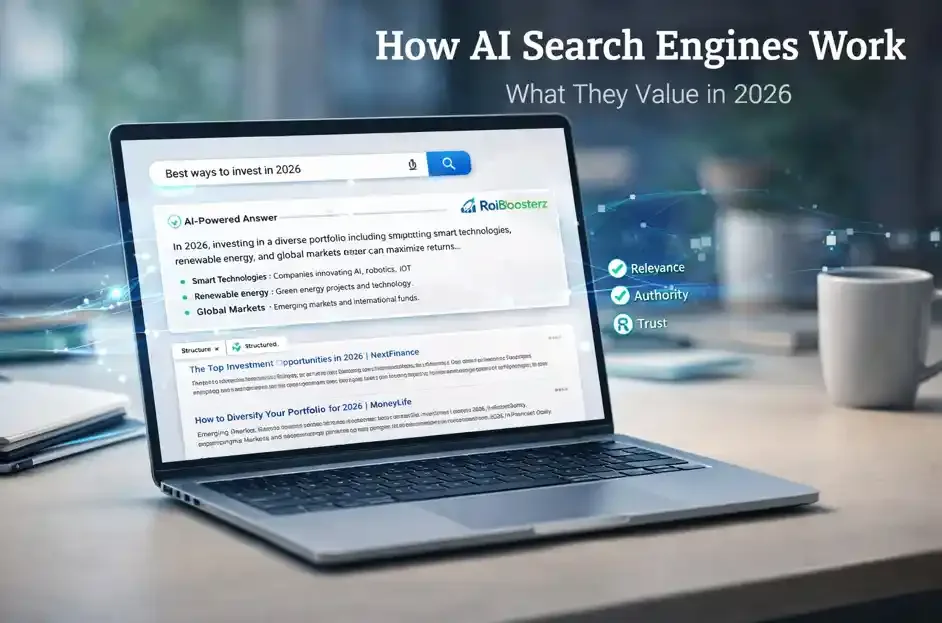
To optimize for generative engines, you need to understand how they choose sources and assemble answers. The process differs significantly from traditional ranking systems.
- Query interpretation: The model understands intent, context, and semantic meaning.
- Knowledge retrieval: It combines learned information with live or indexed source retrieval, depending on the platform.
- Source evaluation: It prioritizes trusted, relevant, well-structured information.
- Answer synthesis: It generates a direct response and may cite brands or sources it considers authoritative.
What LLMs tend to value
- Topical authority and depth
- Clear brand entity recognition
- Well-structured, quotable content
- Cross-source consistency
- Fresh and updated information
The ROI Boosterz GEO Framework
1. AI SEO Audit
Evaluate current visibility in AI-generated results, identify competitor citations, and assess content citability.
2. Entity & Brand Architecture
Strengthen brand recognition using structured data, consistent brand signals, and authoritative mentions.
3. Citable Content Architecture
Create answer-first content with strong structure, evidence, and modular information blocks.
4. Platform-Specific AI Strategy
Adapt optimization approaches for ChatGPT, Gemini, Perplexity, and Copilot based on how each platform retrieves and cites information.
5. Digital PR & Brand Citations
Earn mentions from credible websites, publications, and industry sources that reinforce brand trust.
6. Technical Answer Optimization
Improve FAQs, summaries, schema, internal linking, and renderability so content is easier for AI systems to process.
7. Measurement & Iteration
Track citation frequency, AI visibility share, brand mentions, and conversion impact to improve your strategy over time.
The Future of Search
- Multimodal AI search: Search will increasingly combine text, images, video, and audio.
- Agentic search: AI tools will take actions such as comparing, booking, and recommending on behalf of users.
- Personalized answers: The same search may produce different outputs for different users.
- AI-native content formats: Structured knowledge systems and machine-readable content will become more important.
Businesses that invest in GEO now are building a long-term visibility advantage for the next era of search.
Key Takeaways
- GEO focuses on visibility inside AI-generated answers.
- Traditional SEO is still useful, but no longer enough on its own.
- Brand citations and entity authority are critical in AI search.
- Content must be structured to be quotable, understandable, and citable.
- Measurement now extends beyond rankings into AI visibility and citation tracking.
Ready to improve your AI search visibility?
ROI Boosterz helps brands combine SEO and GEO to build stronger visibility across both traditional search engines and AI-driven discovery platforms.
Explore SEO Services