
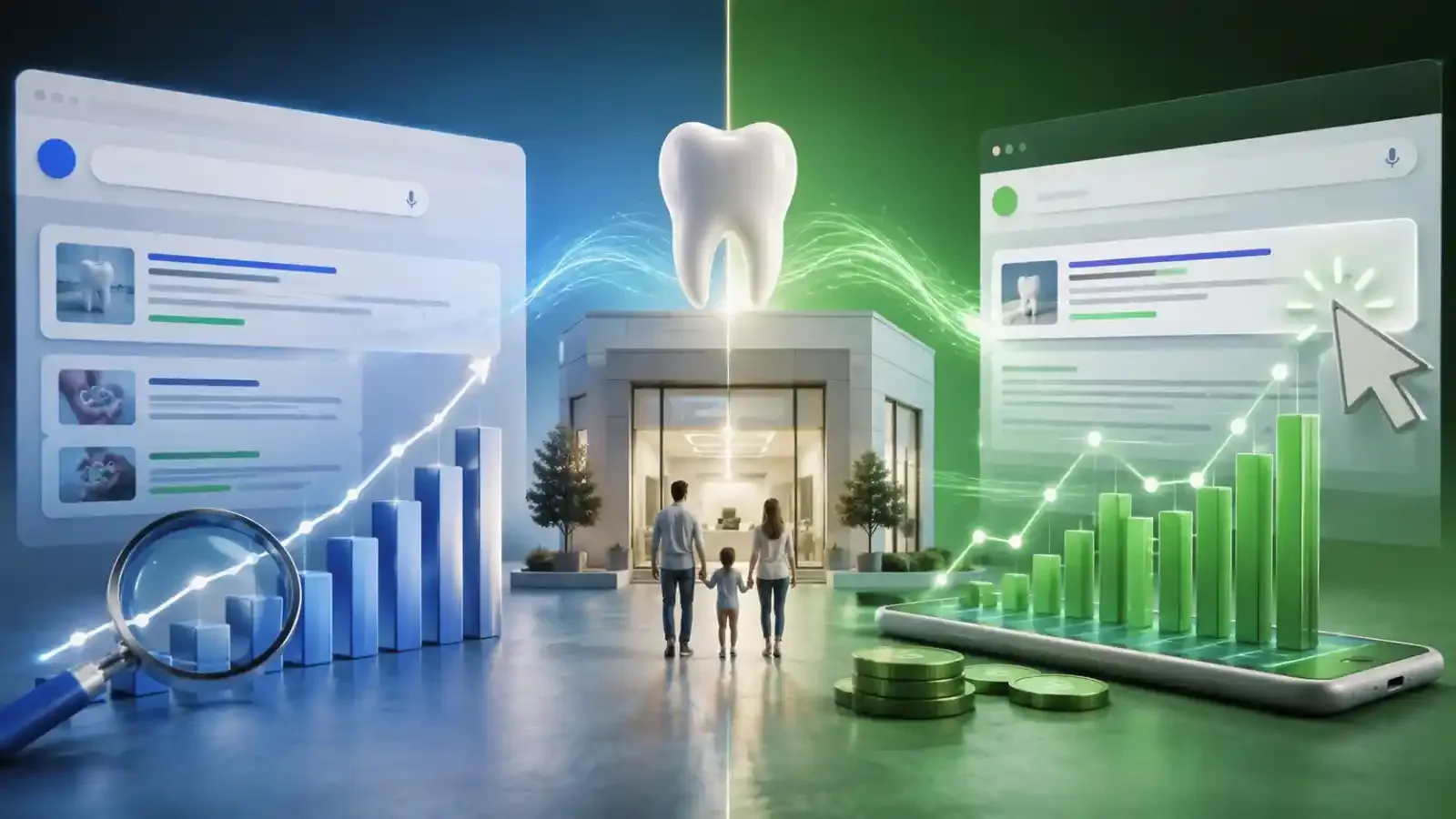
Both dental SEO and Google Ads can bring patients to your practice — but they work differently, cost differently, and suit different situations. Google Ads delivers fast visibility that stops when the budget stops. Dental SEO builds compounding organic traffic that keeps working over time. Most growing practices eventually use both together, but knowing which to prioritize first depends on your budget, your timeline, and where your practice stands right now.
The Core Difference Between Dental SEO and Google Ads
Before comparing costs and results, it helps to understand what each channel actually does.
Dental SEO is the process of optimizing your website and Google Business Profile so your practice appears organically in search results and Google Maps when patients search for dental services nearby. It covers local rankings, treatment page content, technical website health, and citation authority. The work builds over time — and so do the results.
Google Ads (PPC) places your practice at the top of search results immediately, but you pay each time someone clicks. The moment you pause the campaign, the visibility disappears. According to WordStream, the average cost per click for dental keywords in Google Ads ranges from $6 to $20 for general searches, and $30 to $80 or more for high-value treatment terms like dental implants.
Neither channel is universally better. The right choice depends entirely on where your practice is, what it needs, and what it can realistically afford to invest.
How Each Channel Performs Across What Matters Most
Cost Per Patient Lead
This is where the comparison gets practical for most dentists.
With Google Ads, you pay for every click — whether that person books an appointment or not. In competitive dental markets, a practice targeting implant keywords can spend $80 to $150 per click. If 10% of those clicks convert to a lead, the cost per lead lands around $800 to $1,500. For high-value treatments, that math still works. For general check-up appointments, it usually does not.
With dental SEO, the cost per lead decreases significantly over time. You pay a monthly retainer for ongoing optimization work, but organic clicks carry no per-click charge. A practice ranking on page one for "dentist near me" in their city can receive hundreds of qualified monthly visitors without paying for each one. BrightLocal's 2024 data shows that 78% of local mobile searches result in an offline purchase within 24 hours — and organic listings capture a significant share of those clicks.
The important caveat: SEO requires 3 to 6 months before meaningful traffic arrives. Google Ads can start generating calls within days of launch.
Speed of Results
Google Ads wins on speed — and it is not close.
A well-built Google Ads campaign for a dental practice can start generating calls within 48 to 72 hours of going live. For a practice that just opened, needs immediate cash flow, or is launching a new treatment service, this speed is genuinely valuable.
Dental SEO operates on a different timeline. The first 1 to 3 months involve technical fixes, content optimization, and Google Business Profile work. Ranking movement typically begins in months 3 to 5. Consistent, reliable organic patient flow usually arrives between months 6 and 12. Practices that understand this upfront invest patiently and see compounding returns. Practices that expect fast results from SEO are disappointed.
Long-Term Value
This is where dental SEO pulls ahead decisively.
Once your practice earns strong organic rankings — page one for "dental implants near me," top three in the Google Maps pack — those positions continue generating patient inquiries without a daily ad budget. The content and authority you build compounds over time. A blog post ranking for "dental implants cost [city]" can bring in qualified traffic for years.
Google Ads produces no residual value. The moment the campaign pauses, the traffic stops. Every month of paid visibility requires a fresh budget to maintain. Over 24 months, a practice investing $2,000 per month in ads has spent $48,000 with nothing to show structurally — no content, no authority, no lasting rankings.
Trust and Click Behavior
Patients behave differently toward organic results versus ads, and the data reflects this.
A 2023 study by Advanced Web Ranking found that organic search results receive 71% of total clicks across Google search pages, while paid ads capture roughly 15 to 20%. More specifically, patients searching for dental services often skip ads intentionally — they associate organic and map pack results with more trustworthy, established practices.
This does not mean ads are ineffective. It means the two channels attract slightly different patient mindsets. Urgent searches — "emergency dentist open now," "tooth pain today" — convert well through paid ads because the patient needs speed. Research-driven searches — "best Invisalign dentist in [city]," "dental implants near me" — tend to favor organic results where the patient is comparing options before committing.
Competition and Market Conditions
In highly competitive dental markets, both channels become harder and more expensive — but in different ways.
Heavy Google Ads competition drives up cost per click. In a major metro where 20 dental practices are all bidding on the same implant keywords, the cost per click can exceed $100. The practices with the largest ad budgets dominate, and smaller clinics get crowded out.
Heavy SEO competition requires more time and more consistent investment to break through. However, a dental practice that builds genuine topical authority — comprehensive treatment pages, regular content, strong local signals — can outrank larger competitors who have not invested in SEO. Authority is not purely a budget game the way paid auctions are.
Side-by-Side Comparison
| Factor | Dental SEO | Google Ads |
|---|---|---|
| Speed to results | 3–6 months | 48–72 hours |
| Cost structure | Monthly retainer | Pay-per-click |
| Long-term value | Compounds over time | Stops with budget |
| Average cost per lead | Decreases over time | Fixed or rising |
| Trust signals | High — organic = established | Lower — skipped by some patients |
| Best for urgent searches | Moderate | Strong |
| Best for research-phase patients | Strong | Moderate |
| Budget flexibility | Consistent monthly investment | Highly scalable up or down |
| Residual value after stopping | Yes — rankings, content, authority | No |
Which Channel Should a Dental Practice Choose First?
The honest answer is: it depends on three things — your timeline, your budget, and your current online presence.
Start with Google Ads if:
- Your practice is newly opened and needs patients immediately
- You are launching a new high-value service (full arch implants, Invisalign) and need fast traction
- Your website has no existing SEO foundation and you cannot wait 6 months for results
- Your budget allows for $1,500 to $3,000 per month in ad spend
Start with dental SEO if:
- Your practice has been operating for at least a year and can invest in a 6 to 12-month growth plan
- You want to reduce long-term dependence on paid advertising
- Your competitors are ranking organically and capturing the patients who skip ads
- You are investing in treatment-specific content and local authority as a durable patient acquisition asset
Run both together if:
- You have the budget to allocate to each channel separately
- You want Google Ads to cover immediate lead flow while SEO builds the long-term foundation
- You are in a competitive market where organic and paid visibility together dominate more search real estate
- You want to track which channel produces lower cost per patient over 12 months and then shift budget accordingly
At ROIBoosterz, the most effective dental campaigns we build run ads and SEO in parallel — ads handle the short-term, SEO handles the compounding long-term. The two channels reinforce each other rather than compete.
The Combined Strategy: Why Most Growing Practices Use Both
Running dental SEO and Google Ads together is not just about covering more ground. There are specific strategic advantages to using both.
When your practice appears in both the paid results and the organic results for the same search, it takes up more visible space on the page. A patient searching "Invisalign dentist near me" who sees your ad at the top and your website in the organic results and your practice in the Google Maps pack is significantly more likely to click than if you appeared only once.
There is also a data advantage. Google Ads gives you conversion data almost immediately — which keywords generate calls, what time of day patients convert, which treatment terms produce the most inquiries. That data can directly inform your SEO keyword strategy, helping you prioritize the organic content that is most likely to generate real patient leads rather than just traffic.
For practices ready to build a proper local search strategy, our dental seo services page covers how we approach the SEO side of this, and our local seo for dentists resource explains the local-specific components in more detail.
Key Takeaways
- Google Ads delivers fast patient leads but produces no lasting value when the budget stops
- Dental SEO builds compounding authority and lower cost-per-lead over 6 to 24 months
- Patients in the research phase trust organic results more than ads — treatment searches favor SEO
- Urgent searches like emergency dentistry convert well through paid ads
- The strongest dental marketing strategy combines both channels — ads for now, SEO for the long term
- Your practice size, budget, and timeline should determine which to prioritize first
Frequently Asked Questions
Both work, but for different reasons. Google Ads is better for fast, immediate patient volume — especially for urgent searches or new practices. Dental SEO is better for sustainable, lower-cost patient acquisition over 12 to 24 months. Most established practices benefit most from running both together.
Most dental practices spend $1,500 to $5,000 per month on Google Ads, depending on their market and the treatments they are promoting. High-value services like dental implants and full-arch restoration require larger budgets because the cost per click is significantly higher — often $30 to $80 per click in competitive cities.
Yes. Organic SEO and Google Business Profile optimization allow practices to appear in search results and Google Maps without paying per click. It takes 3 to 6 months of consistent SEO work to reach competitive rankings, but the traffic it produces carries no per-click cost.
Research consistently shows that many users — particularly those in the comparison phase — distrust ads and associate organic results with more established, credible businesses. For patients researching implants, cosmetic dentistry, or choosing a long-term family dentist, organic results often generate higher conversion rates than ads.
For general dentistry, a cost per lead below $80 is considered strong. For high-value treatments like implants or Invisalign, a cost per lead of $150 to $400 is common and still profitable given the treatment revenue. Dental SEO tends to produce lower cost per lead over time as organic rankings compound without added per-click cost.
A new practice should typically start with Google Ads because SEO takes 3 to 6 months to produce results. Running ads immediately generates patient calls while the SEO foundation is being built in parallel. Once organic rankings start contributing leads, the ad budget can be reduced or redirected toward higher-value treatments.
Directly, no — Google does not reward paid advertisers with higher organic rankings. However, running ads generates data about which keywords convert to actual patient calls, and that data can be used to prioritize the most valuable organic content. The two channels inform each other even though they operate independently in terms of ranking.