
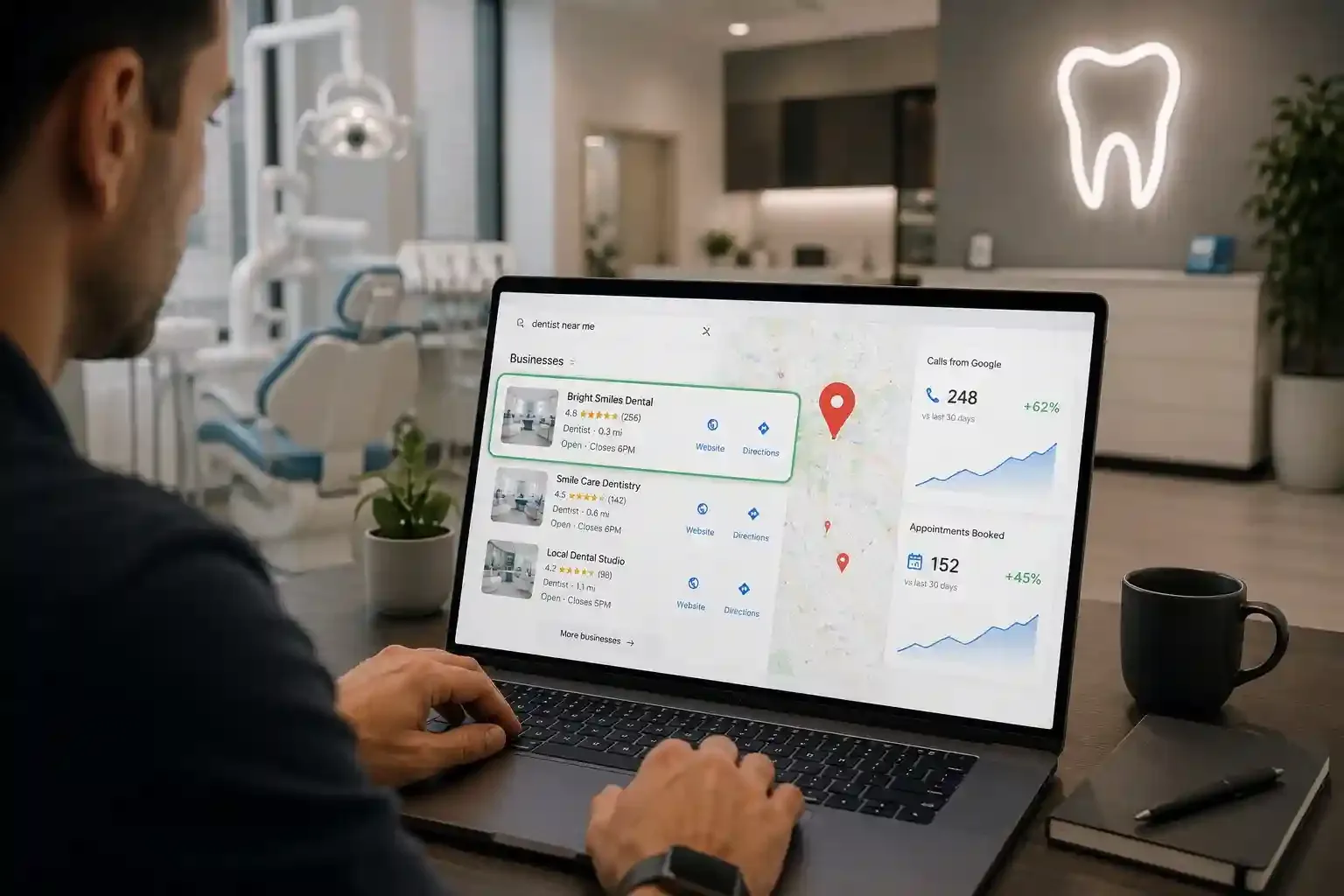
The Google Map Pack is the block of three local business listings that appears at the top of Google when someone searches "dentist near me" or "dental implants [city]." Getting into those top three positions means capturing the largest share of new patient calls from local search. The steps that move a dental practice into the map pack are specific and sequential: claim and complete your Google Business Profile, build NAP consistency, collect reviews, add local signals to your website, and build local citations. This guide walks through each one.
Why the Google Map Pack Matters More Than Regular Rankings
Most dentists focus on ranking in the traditional "blue link" organic results. The map pack deserves more attention.
Studies by BrightLocal show that the Google Map Pack receives 44% of all clicks on a local search results page — more than the organic listings below it. When a patient searches "dentist near me" on their phone, the map pack is the first thing they see. The three practices listed there get the call. Everyone else does not.
For high-value treatment searches — "dental implants near me," "Invisalign dentist [city]," "emergency dentist open now" — map pack visibility is often the difference between a phone that rings and one that does not. A practice ranking #1 in organic results but absent from the map pack will consistently lose patient calls to a competitor ranked #3 in organic but present in the local pack.
Understanding this changes where you invest your SEO effort.
How Google Decides Who Gets into the Map Pack
Google uses three core factors to determine local pack rankings. Every step in this guide connects directly to one of them.
Relevance — Does your business match what the patient searched for? A Google Business Profile with accurate categories, services, and descriptions signals relevance.
Distance — How close is your practice to where the patient is searching from? This factor is partially outside your control, but website local signals and service area settings influence how Google interprets your geographic reach.
Prominence — How well-known and trusted is your practice online? Reviews, citations, backlinks, and overall online presence all feed into this.
The steps below address all three. Most practices that are not in the map pack have fixable gaps in at least two of these areas.
Step 1: Claim and Verify Your Google Business Profile
Everything starts here. A Google Business Profile (GBP) that is unclaimed or unverified will not rank in the map pack — full stop.
Go to business.google.com and search for your practice. If it appears but is unclaimed, claim it. If it does not appear, create it from scratch. Google will send a verification postcard to your practice address, or in some cases offer phone or email verification.
Once verified, do not treat this as done. Verification is the entry requirement. Optimization is what produces rankings.
Step 2: Complete Every Section of Your Google Business Profile
An incomplete GBP is one of the most common reasons dental practices do not rank in the map pack. Google rewards profiles that give it complete, accurate information to work with.
Work through every section:
- Business name — Use your exact legal practice name. Do not add keywords to your business name ("Best Dental Implants Dentist Chicago") — Google considers this spam and can suspend the listing.
- Primary and secondary categories — Your primary category should be "Dentist." Add secondary categories that match your services: "Cosmetic Dentist," "Emergency Dental Service," "Dental Implants Provider," "Orthodontist," if applicable. Categories are one of the strongest relevance signals in the map pack algorithm.
- Address and service area — Enter your exact address. If you see patients at your location, do not hide the address. Add a service area covering your city and surrounding neighborhoods.
- Phone number and website — Use a local phone number, not a tracking number, as your primary GBP number. Link to your main website homepage.
- Hours — Keep these accurate and updated. Incorrect hours lead to negative reviews and signal unreliability to Google.
- Services — This section is underused by most dental practices. Add every treatment you offer with a short description for each. "Dental Implants — We place and restore dental implants at our [city] practice, including single implants, implant-supported bridges, and All-on-4 restorations." The more complete this section is, the more searches your profile becomes relevant for.
- Business description — Write 200 to 300 words covering your practice, your team, your primary services, and your location. Use natural language. Include your city name and two or three of your primary treatment terms naturally within the text.
Step 3: Add Photos Consistently
Photos are a stronger ranking signal than most dentists realize. According to Google's own data, businesses with photos receive 42% more requests for directions and 35% more website clicks than businesses without them.
Upload a minimum of 20 photos across these categories: exterior of the building, reception and waiting area, treatment rooms, equipment, team photos, and before-and-after treatment photos (with patient consent). Add new photos at least once per month. Consistent photo uploads signal an active, maintained profile — which Google rewards in local rankings.
Step 4: Build a Consistent NAP Across the Web
NAP stands for Name, Address, and Phone number. When your practice details appear differently across websites — "Dr. Smith Dental" on Google, "Smith Family Dentistry" on Yelp, a different phone number on Healthgrades — Google treats this as a trust problem. Inconsistent NAP reduces map pack rankings because Google cannot confidently verify your business information.
Audit your NAP across the following sources and correct any inconsistencies:
- Google Business Profile
- Yelp
- Healthgrades
- Zocdoc
- WebMD
- Facebook Business Page
- Your own website (footer, contact page, schema markup)
- Local chamber of commerce listing
The name, address, and phone number must be identical — same abbreviations, same suite format, same spelling — across every source.
Step 5: Generate and Respond to Google Reviews
Reviews are one of the most influential prominence signals in Google's local ranking algorithm. Moz's Local Search Ranking Factors report places review signals — quantity, velocity, and diversity — among the top factors separating map pack rankings from non-pack positions.
For most dental practices, the fastest path to more reviews is the simplest: ask every satisfied patient. A short follow-up text or email with a direct link to your Google review page removes friction and significantly increases response rates. According to BrightLocal, 70% of consumers will leave a review when asked — the asking is what most practices skip.
Responding to every review — positive and negative — signals active management and builds trust with both Google and prospective patients reading your profile.
Step 6: Add Local SEO Signals to Your Website
Your website and your Google Business Profile work together. A GBP linked to a website with strong local signals ranks better than one linked to a generic site with no location content.
Add these local signals to your website:
- Location-specific title tags and headers — "Dental Implants in [City] | [Practice Name]" on your implants page performs better than "Dental Implants" alone.
- LocalBusiness schema markup — This structured data tells Google your practice name, address, phone number, hours, and service area in a machine-readable format. Most website platforms support schema plugins; if yours does not, a developer can add it manually.
- Embedded Google Map — Add a Google Maps embed to your contact page. This reinforces the geographic association between your website and your GBP.
- Location mentions in page content — Reference your city, neighborhood, and surrounding areas naturally in your service page content. "Our dental implant patients come from [city], [neighborhood], and surrounding communities, including [nearby town]" gives Google geographic context without reading unnaturally.
Step 7: Build Local Citations
A local citation is any mention of your practice name, address, and phone number on another website. Citations from reputable directories build the prominence signal that Google uses to assess how established and trustworthy your practice is.
Start with the most authoritative dental and local directories:
- Healthgrades
- Zocdoc
- WebMD Health Services
- American Dental Association directory
- Your state dental association directory
- Local business directories and the chamber of commerce
- Apple Maps and Bing Places (often overlooked but still relevant)
Aim for 40 to 60 consistent citations across authoritative sources. Quality matters more than volume — a listing on Healthgrades carries far more weight than twenty listings on low-quality directories no one visits.
How Long Does Map Pack Ranking Take?
Google Business Profile improvements produce results faster than standard SEO. Practices that complete their profile, fix NAP inconsistencies, and begin generating reviews consistently often see local pack movement within 4 to 8 weeks.
Full map pack entry for competitive city-level searches — "dentist [city]," "dental implants [city]" — typically takes 3 to 5 months of sustained effort. Less competitive neighborhood-specific searches often move faster.
The timeline depends on how many of the steps above start from zero versus are already partially in place.
Steps at a Glance
| Step | What It Addresses | Impact |
|---|---|---|
| Claim and verify GBP | Entry requirement | No ranking without this |
| Complete every GBP section | Relevance | Categories and services drive search matching |
| Add photos consistently | Prominence | 42% more direction requests per Google data |
| Fix NAP consistency | Trust / Prominence | Inconsistency actively suppresses rankings |
| Generate and respond to reviews | Prominence | Top factor in local pack algorithm |
| Add local signals to website | Relevance + Distance | Website reinforces GBP geographic signals |
| Build local citations | Prominence | Establishes practice authority across the web |
Key Takeaways
- The Google Map Pack receives 44% of clicks on local search pages — more than organic results
- Google ranks map pack results on three factors: Relevance, Distance, and Prominence
- An incomplete or unclaimed Google Business Profile will not rank in the map pack
- Categories are one of the strongest relevance signals — add every applicable secondary category
- NAP inconsistency across directories actively reduces local pack rankings
- Reviews with consistent velocity matter more than a one-time burst — ask every patient
- Local signals on your website reinforce your GBP and strengthen geographic relevance
- Map pack movement for a well-optimized profile often begins within 4 to 8 weeks
Frequently Asked Questions
The Google Map Pack is the block of three local business listings that appears at the top of Google search results for location-based queries like "dentist near me" or "dental clinic [city]." It includes a map, the practice name, star rating, address, and phone number. It appears above the standard organic results and captures a large share of local patient clicks.
For most dental practices, initial map pack movement begins within 4 to 8 weeks of completing and optimizing the Google Business Profile. Ranking in the top three for competitive city-level searches typically takes 3 to 5 months of consistent effort covering GBP optimization, review generation, NAP consistency, and citation building.
Technically yes — a Google Business Profile alone can appear in the map pack. In practice, practices with optimized websites linking to their GBP consistently outrank those without one. Website local signals — schema markup, location-specific pages, embedded maps — reinforce the GBP's geographic and relevance signals in meaningful ways.
The most common reasons are an incomplete or unclaimed Google Business Profile, missing secondary categories, NAP inconsistency across directories, too few reviews compared to competing practices, and a website without local SEO signals. Running a Google Business Profile audit against the steps in this guide will identify which gaps are holding back your visibility.
Yes. Review quantity, recency, and consistency are confirmed local ranking signals. A practice with 200 reviews averaging 4.8 stars will almost always outrank a practice with 30 reviews averaging 4.9 stars, all else being equal. The velocity matters too — generating 5 reviews per month consistently signals more than getting 50 reviews in one month and nothing for six months after.
NAP stands for Name, Address, and Phone number. When these details appear differently across Google, Yelp, Healthgrades, and other directories, Google cannot confidently verify your business information — and uncertainty reduces rankings. Consistent NAP across all directories signals to Google that your practice is legitimate, established, and correctly located.
For a fuller picture of how local search ranking fits into a complete dental SEO strategy, our local seo for dentists resource covers the broader local SEO framework that map pack optimization sits within.
At ROIBoosterz, Google Business Profile optimization is the first thing we address in every dental SEO campaign — because it is the fastest-acting lever in local search visibility, and most practices have significant room to improve it.